
U.S. PLANNED TO A-BOMB N. KOREA IN 1950 WAR
Page 2
MacARTHUR NOW CONSIDERS USING THE "BOMB" - Nuclear Weapons And Aircraft Waited For Orders
With the oncoming defeat a distinct possibility, talk of using the Atomic Bomb was making the rounds. General Hoyt Vandenberg, speaking for the Air Force, suggested they were prepared to use it. MacArthur suggested a plan to use numerous bombs. The U.S. had a stockpile of nearly 300 air-burst bombs. Only President Truman could order them used. MacArthur was insisting he be given the sole right to use 50 bombs as he saw fit. He insisted on bombing the Yalu power plants with multiple strikes by B-29s. Suggestions came from all services and every General offered his own plan. Truman announced the U.S. was considering using the Atomic weapon against North Korea. The situation brought up a question in my mind: Our entire military complex was announcing their plans to drop the bomb, but MacArthur, with the same idea, was criticized for planning the same thing. A state of affairs was rapidly going from bad to disastrous. In the war room Vandenberg dismissed the idea of further reprimands to MacArthur. "What good would it do? He won't obey the orders". General Ridgway exploded. "You can relieve any commander who won't obey orders, can't you?" Thus the idea of relieving MacArthur was on the table. He again requested that the Pentagon grant him a field commander's discretion to employ nuclear weapons as necessary. He wanted them stockpiled in Okinawa, which they were finally stored ready for use after MacArthur's request was denied. His plan was to drop between 30 and 50 atomic bombs-strung across the neck of Manchuria, and spread behind us, from the Sea of Japan to the Yellow Sea- a belt of radioactive cobalt for at least 60 years there would be no invasion of Korea from the North. The Russians, he claimed, would be intimidated by this and do nothing. He continued to strongly seek authority to deploy the bomb.
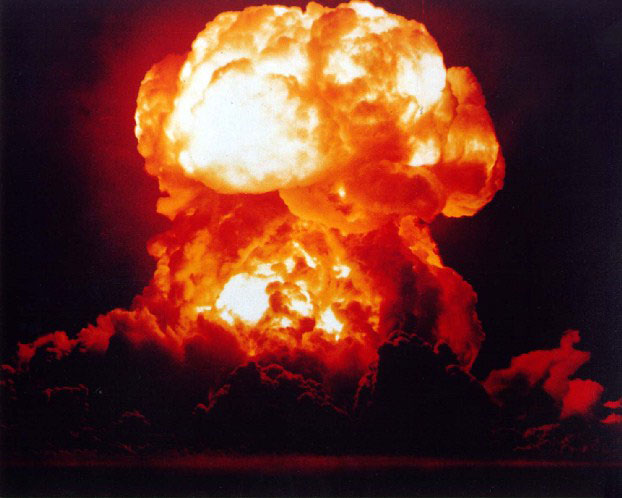
NEVADA TEST SITE, OPERATION PLUMBOB SERIES 57 kt
TRUMAN FIRES INSUBORDINATE MacARTHUR
With all American forces in full retreat, some of the decisions made by MacArthur were accused of accelerating the crisis. American losses, particularly marines, reached the unacceptable range. The U.S. retreat was humiliating. The conversations now turned to total evacuation of our forces. General Ridgway assumed more and more responsibility in decision making. MacArthur rejected any type of negotiated settlement. He had derailed the U.S. initiative which was actually a dare for China to continue the war. He had always wanted a war with China. The Pentagon received his message, which infuriated many high ranking officials.
Truman had considered firing MacArthur many times previous to this, but this was the last straw. Actually the order of Dec. 6 which MacArthur had disobeyed was explicit enough to warrant court-martial proceedings. MacArthur's statements were causing consternation in Washington as was his insulting personal letter to Ridgway. His advice letter to the House of Representatives again infuriated everyone. MacArthur wanted a war with China, and his leadership could no longer be tolerated. A meeting was held with Truman to determine how to get rid of MacArthur. Truman insisted "I'm going to fire the son of a bitch right now". MacArthur was ordered to turnover his command to Lt. General Ridgway. General Bradley warned Truman that if MacArthur heard about the orders before they reached him officially he might resign with an arrogant flair. Truman exclaimed "The son of a bitch isn't going to resign on me, I want him fired". MacArthur's dismissal was announced on late night radio: " I have decided that I must make a change in command in the Far East. I have, therefore, relieved General MacArthur of his command and have designated Lt. Gen. Matthew Ridgway as his replacement".
U.S.THREATENS ATOMIC WARFARE
On Nov. 5 1950, the Joint Chiefs of Staff issued orders for the retaliatory atomic bombing of Manchurian military bases, if either their armies crossed into Korea or if PRC or KPA bombers attacked Korea from there. The President ordered the transfer of nine Mark-4 nuclear capsules "to the Air Force's Ninth Bomb Group, the designated carrier of the weapons, and signed an order to use them against Chinese and Korean targets.
On Nov. 30, 1950, the USAF Strategic Air Command was ordered to "augment it's capacities, and this should include atomic capabilities.
President Truman remarked that his government was actively considering using the atomic bomb to end the war in Korea but that only he commanded atomic bomb use.
In 1951 the U.S. escalated closest to atomic warfare in Korea. Because the PRC had deployed new armies to the Korean frontier, pit crews at the Kadena Air Force Base, Okinawa, assembled atomic bombs for Korean warfare, lacking only the essential nuclear cores. In Oct. 1951, the U.S. effected Operation Hudson Harbor to establish nuclear weapons capability. USAF B-29 bombers practiced individual bombing runs (using dummy nuclear or conventional bombs) from Okinawa to North Korea, coordinated from Yokota AFB in Japan. Hudson Harbor tested "actual functioning of all activities which would be involved in an atomic strike, including weapons assembly and testing, leading to ground control of bomb aiming". There were an increasing number of suggestions on precisely how the atomic bombing of N. Korea would be conducted. Robert Oppenheimer, director of "the Manhatten Project", was designated a consultant in the tactical use of the A-bomb.
With atomic weapons already on Okinawa, the stage was set to proceed with the actual detonation of numerous nuclear bombs. It was suggested that General Curtis LeMay be put in charge of the actual drops. All ranking officials plus The President of the U.S. agreed to the plan. Everything was ready, just waiting for the "word".
As we all know the "war" ended just about where it started. The stalemate was insulting to the U.S., as we had lost the war. The humiliation went deep, as the tragic loss of 36,913 of our best men will always be difficult to accept.
It is somewhat ironic that after 60 years we are still legally at war. Perhaps we should have proceeded with our plan in the 50s war, as we are again faced with the same problem. The situation now is not the same as 1950. N. Korea is one of the best prepared nation militarily for any kind of confrontation, on land or nuclear. They are equipped with top Russian fighters, and highly accurate surface to air missiles. Thought must be given to the fact that they have several atomic weapons which can be delivered short or long range from mobile launchers. It is not a mistake to predict they will very soon have ICBM which could reach any part of the U.S.
N.KOREA HAS A STOCKPILE OF CHEMICAL WEAPONS
N. Korea has had for some time a substantial arsenal of chemical weapons. It reportedly acquired the technology necessary to produce large amounts of nerve agents with the means to launch them. N. Korea has expended considerable resources on equipping it's army with chemical protection equipment. Their capability to launch missiles containing nerve agents is possibly more frightening than the a-bomb. In a relatively few short years they will have the capability to strike the U.S. with not only nerve agents but possibly the neutron bomb. The U.S. has allowed this to happen, and has nobody to blame but itself. We allowed this to happen, and will live to regret it.
Personal opinion of Wayland Mayo, website historian.

